
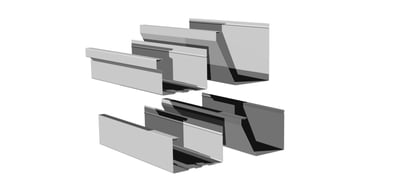
Custom Gutter Profiles: What's Possible When Standard K-Style Isn't the Spec
Most gutter jobs run on the same short list of profiles. K-style, half-round, and fascia cover almost everything a crew sees in a normal week. There's a reason for that. Stock tooling keeps those jobs fast to quote and cheap to run. Then a set of architectural drawings comes across the desk, or a homeowners association calls about matching a 1920s bungalow. None of the machines in the shop can touch it. That's the moment a lot of contractors turn the job down, or hand it off to someone else who walks away with the margin.
This article is for the contractor on the other side of that decision. It's also for shop owners weighing a specialty machine investment and specifiers trying to figure out who can build what's on the drawing. We'll get into what a specialty profile is, which projects tend to need one, and how KWM Gutterman builds a machine for it.
We'll also show what it takes to move from declining those calls to becoming the contractor who can take them on. Because KWM Gutterman engineers and builds its specialty tooling and machines in-house at its Rockdale, Illinois, facility, contractors can access many of the capabilities described below.
What Are Specialty Gutter Profiles?
Put simply, a specialty gutter profile is anything that doesn't come off the standard K-style, half-round, or fascia shelf. Someone needed a particular cross-section, a specific dimension, or a bead that matches what's already on the building. Maybe they needed a face that just looks a certain way. Whatever the reason, a stock profile couldn't deliver it. That's the whole category.
Specialty profiles can differ from standard 5" and 6" gutters in shape, depth, width, or decorative detail. What makes them specialty is the geometry, not the metal. Most specialty configurations run aluminum, copper, or steel coil, depending on the design and the material thickness, so a copper straight face profile and an aluminum one are both still specialty. For a refresher on the two profiles most crews run every day, see Half Round vs K Style Gutters. Browse the current lineup of specialty gutter profiles.
When Projects Call for a Specialty Profile
There's a short list of situations that keep coming up whenever specialty work lands on a desk. Once a contractor learns to spot them, a job that might have gotten a quick no starts looking like something worth bidding.
Historic and Restoration Work
This is where specialty requests show up most. A gutter installed on a building 60 or 100 years ago rarely resembles anything sold off the shelf today. A preservation board or property owner often wants that original look kept intact rather than swapped for a modern K-style. Partial replacements and additions face the same problem. The new section has to disappear into what's already there, not stick out next to it.
Architectural and Design-Driven Projects
An architect will sometimes spec a particular face or bead detail simply because it fits the building's overall look. This shows up more often on modern, minimalist designs, where a plain, straight-face gutter reads better than a decorative K-style. On a custom home especially, the gutter isn't something the owner wants hidden. It's part of the exterior they're paying for.
Non-Standard Dimensional Requirements
Sometimes the issue is simpler than style. A roof is bigger than a standard system was built to handle. Or the fascia and trim on the building only work with an unusual profile. Commercial and institutional jobs run into this constantly. A spec sheet will often name a box gutter profile or another exact shape that a standard K-style machine has no way to produce.
Examples of Specialty Profile Configurations
A few concrete examples make the category easier to picture. A straight face gutter replaces the decorative K-style front with a clean, minimal face. KWM Gutterman offers this as the 5/6" Combo IronMan Straight Face Profile, built for dual-size operation on 5" and 6" gutters, alongside single-size 5" and 6" straight face versions.
Box profiles serve high-end residential, light commercial, and commercial projects that call for a box-style gutter shape. A box gutter profile like this is available from KWM Gutterman in both European Box and KWM Box configurations. Sizes run 5", 6", and 5/6" combo, and the 7" commercial box profile is built to order for contractors working at that size.
The fascia line has its own variation. The Wide Bottom IronMan Fascia Gutter Machine produces 5" wide-bottom fascia profiles for installations that need an increased material base width. It sits alongside KWM Gutterman's 4.5" and 5" fascia machines.
In addition to the profiles listed with the specialty machines, KWM Gutterman offers more than 30 custom profiles in total. Additional custom and specialty profiles are available upon request.
Why Specialty Profiles Need a Dedicated Machine
Most contractors start by asking if a specialty profile can run on a machine they already own. It can't. Every specialty profile is formed on its own dedicated machine, built for that specific shape.
That also closes off the idea of getting there through parts. Tooling and components can't be purchased separately to turn an existing machine into one that forms a custom profile. A custom profile comes as a complete specialty machine, built as a variation of the IronMan and combo models.
Each of those machines is engineered and built at KWM Gutterman's Rockdale, Illinois facility. Replacement parts are available for all specialty-profile machines.
How to Order a Specialty or Custom Machine
Specialty and custom machines typically aren't ordered through an online cart, and what gets built depends on the project.
The way to start is to contact KWM Gutterman and schedule a consultation. It helps to have the profile in hand, taken from drawings, a sample, or measurements of the existing gutter, along with the sizes and the material and gauge the work will run. Available sizes depend on the project requirements, and what a design can run depends on the material and its thickness.
The Business Case for Specialty Profile Capability
This isn't just a nice-to-have for the rare job that calls for it. Run the numbers and specialty capability holds up as a real business decision on its own.
Most shops in a given market simply can't touch a non-standard profile. That means a contractor who can is bidding against a much shorter list of competitors, on work that tends to pay better than another standard residential run. It also opens doors that stay closed to K-style-only operations. Restoration boards, historic districts, and preservation projects tend to work only with contractors who can match what's already there. Architects and GCs remember who solved that problem for them, too, and that turns into referral business rather than one-off jobs.
There's a margin angle as well. A contractor without a specialty machine usually subcontracts the specialty piece of a job and hands part of the profit to whoever does have one. Owning that capability means keeping the whole job in-house instead. In a market where every truck on the block runs the same K-style profile, the shop that can say yes to something different stands apart. It's one of the few real ways left to avoid a price war.
Standard vs Specialty Profiles at a Glance
The differences between standard and specialty work show up clearly once they're placed side by side.
| Factor | Standard Profiles | Specialty / Custom Profiles |
|---|---|---|
| Typical projects | Residential volume work | Architectural, historic, spec-driven |
| Machine | Standard K-style, half-round, and fascia machines | Dedicated machine built for the profile |
| Competition | High | Low |
| Margin potential | Standard | Higher |
| Ordering | Off the shelf | Consultation-based |
Is Specialty Capability Right for Your Business?
Not every shop needs to make this move right now, and that's a fair answer for plenty of contractors. Here's a simple way to tell where a given business stands.
Strong Fit
A few signs point toward specialty capability being a smart move right now rather than a someday project. Contractors already working in markets with historic districts, architectural custom homes, or active restoration work have recurring demand sitting right in front of them. The same goes for businesses already turning down or subcontracting profile-specific jobs. That opportunity cost is already showing up on the P&L. Contractors with existing relationships with architects, specifiers, or restoration general contractors have a referral pipeline for specialty work partly built already. And established operations looking to differentiate rather than compete on residential price will find specialty work is a real way out of a race to the bottom.
Consider Timing
On the other hand, a few situations suggest it's fine to wait, or to keep subcontracting for now. Newer operations still building consistent standard-profile volume are usually better off putting core volume and cash flow first. Markets with little architectural, historic, or specification-driven demand may not have an addressable opportunity that justifies the investment yet. And contractors who encounter specialty requests rarely enough that subcontracting still makes sense don't necessarily gain much by owning a specialty machine outright. A consultation clarifies if the opportunity is real in a given market, which makes it a reasonable first step even for contractors who are still on the fence.
FAQs About Specialty and Custom Gutter Profiles
Quick answers to the questions contractors and specifiers ask most often when evaluating specialty gutter profile capability.
What is a specialty gutter profile?
A specialty gutter profile is a custom-formed gutter shape made for a unique architectural style, a historical restoration, or a project requiring non-standard dimensions, and it falls outside the standard K-style, half-round, and fascia offerings.
Can KWM Gutterman create specialty gutter machine profiles?
Yes. KWM Gutterman can manufacture specialty gutter machine profiles upon request, so a project that needs a shape outside the standard lineup is worth a conversation.
Do specialty profiles require a completely separate machine?
Yes, always. A specialty profile needs a machine built for that shape, so it can't run on equipment a contractor already has.
Can I buy parts to make my existing machine run a custom profile?
No. Parts and tooling aren't sold as a way to convert a machine you already own. Instead, a custom profile means ordering a specialty machine, and that starts with a consultation.
What is a straight face profile and when is it used?
A straight face gutter replaces the decorative K-style front with a clean, minimal face, commonly specified on modern or minimalist architectural designs. KWM Gutterman offers this as the 5/6" Combo IronMan Straight Face Profile and in single-size 5" and 6" versions.
Can a custom profile match an existing historic gutter?
Matching a historic profile is one of the situations specialty profiles are made for. Bring drawings, a sample, or measurements of the existing gutter to a consultation to find out if it can be built.
How do I start the custom profile process?
Contact KWM Gutterman to schedule a consultation. Custom specialty machines are typically ordered that way rather than online.
Are replacement parts available for specialty-profile machines?
Yes. Replacement parts are available for specialty-profile machines.
Where are specialty machines manufactured?
All specialty gutter machines are engineered and built at KWM Gutterman's facility in Rockdale, Illinois.
Can specialty profiles run in copper, steel, and aluminum?
Most specialty configurations can run aluminum, copper, and steel coil, depending on the specific design and material thickness involved.
Talk to KWM Gutterman About Specialty and Custom Profiles
KWM Gutterman engineers and builds its specialty machines in Rockdale, Illinois. Explore specialty configurations including the 5/6" Combo IronMan Straight Face Profile and the full Specialty Profiles lineup.
For contractors who want to add profiles other than standard K-style, KWM Gutterman also builds half-round and fascia machines. The Max Profile machines form a reinforced, deeper version of K-style, and every machine is browsable from the main machines lineup. Free factory training is available with a purchase, and replacement parts and ongoing technical support are available after the sale.
Contractors can also explore financing options to spread the cost of a machine over time. Because each specialty machine is built around the project, the next step is to contact KWM Gutterman.
If a project spec calls for a profile you cannot produce today, that is a conversation worth having. Talk to KWM Gutterman about specialty machines built to match the profiles your market is asking for.