
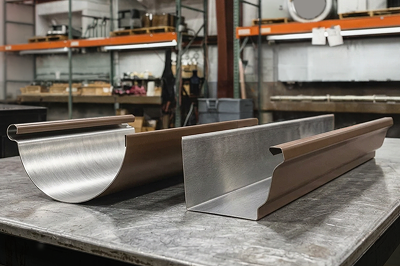
K Style Gutters vs Half Round: Comparison Guide
If you're a gutter installer, machine operator, or exterior renovation pro, you know that choosing between K-style gutters vs half-round profiles can impact everything from your installation workflow to long-term customer satisfaction.
Understanding the differences between these gutter profiles can also help with material ordering, seamless gutter machine selection, and advising clients on the best fit.
Gutter Types: Half-Round vs K-Style Gutters
Let's start with the basics. Among the most common types of gutters, the two leading profiles are K-style gutters (also called "ogee" or "K gutters") and half-round gutters. While both serve the same purpose to channel rainwater away from the structure, their design, performance, and install process differ.
What Are K-Style Gutters?
K-style gutters are the most widely installed gutter profile in the U.S. These gutters have a flat back and bottom with a front edge that mimics decorative crown molding. This shape increases capacity and allows for longer runs without added support, making K gutters a great fit for modern residential buildings.
What Are Half-Round Gutters?
Half-round gutters form a smooth half-circle. This shape offers better water flow and less debris buildup but may require closer hanger spacing. Half-rounds are especially popular in restoration projects, custom homes, and high-end properties due to their classic appearance and compatibility with materials like copper.
Gutter Machine Compatibility & Profile Roll-Forming
Machine selection and setup can make or break your installation day. The profile you choose has a direct effect on your tooling, changeover time, and production speed.
At KWM Gutterman, we manufacture industry-leading machines like the Ironman, capable of producing K-style and half-round profiles with speed and precision. Our machines are modular, built for reliability, and easy to maintain.
Machine Considerations
- Tooling Differences
K-style uses sharp dies and angled rollers, half-round needs custom rollers for the curved shape and smooth edge. - Changeover Time
Swapping from one profile to another requires reconfiguring tooling and coil guides. A well-trained crew can complete this in under 2 hours with the right machine. - Coil Requirements
Both use aluminum and copper coils, but half-round sometimes needs narrower widths depending on the profile depth. - Seamless Capabilities
KWM machines can run seamless half-round gutters in the field, an option not available with many competitors. - Maintenance
Half-round rollers are more sensitive to alignment issues due to their shape, so routine calibration matters.
The KWM Half-Round Machine
Half-round forming asks more of a machine than K-style does, and the specification reflects that. The 6" Reverse Curl Half Round Gutter Machine (SKU: 10000G2) is built around chrome-plated 416 stainless steel radius forming rollers and a three-station polyurethane drive train integral to the forming rollers, which is what holds a rounded profile true across a long run.
- 1 1/2 HP, 110 volt, single phase, 18 amp TEFC motor, against the 3/4 HP motor used on the K-style IronMan machines
- Approximately 35 feet per minute
- Welded tubular frame with a front pull guillotine shear and push-button jog controls
- Runs .032 aluminum, 16 to 20 oz copper, and 24-gauge painted steel and Galvalume
- Manufactured in Rockdale, Illinois
That extra motor capacity and roller specification is the practical reason half-round carries a higher machine cost than a comparable K-style unit, and it is worth factoring into the tooling line of any margin calculation below.
Capacity & Performance: Water Flow, Strength & Load Handling
Let's compare K-style vs half-round gutters based on what really matters in the field.
| Profile Type | Flow Rate (in/hr) | Ideal Bracket Spacing | Snow Load Tolerance | Sag Resistance |
|---|---|---|---|---|
| K-Style 5" | 5.0 | 24"–36" | High | Excellent |
| Half-Round 5" | 3.5 | 18"–24" | Medium | Good |
Insights
- Water Flow - K-style handles more water per inch due to its angular design and deeper trough.
- Overflow Risk - Half-round can overflow more quickly in sudden downpours unless oversized or paired with larger downspouts.
- Debris and Snow Load - K-style's flat bottom can collect more debris but also withstand more weight. Half-round tends to shed debris more easily but may sag under heavy snow if not properly supported.
Cost Analysis: Material, Waste & Margin Implications
Margins matter. When comparing half-round gutters vs K-style gutters, it's about raw material cost, total install time, waste, and resale value.
Cost Factors
- Material Cost - K-style aluminum is generally cheaper per linear foot. Half-round copper is more expensive but has higher markup potential.
- Scrap Rates - Half-round profiles often create more scrap due to curved cuts and specialty accessories.
- Labor Cost - K-style is faster to install for most crews, keeping labor hours lower.
- Tooling Cost - Running half-round requires a machine investment.
- Resale Margin - Half-round gutters with decorative accessories (like cast brackets or copper leader heads) offer higher upsell value in premium markets.
Maintenance, Client Expectations & Warranty Liability
Contractors know that callbacks can kill profits. The right profile choice can significantly reduce long-term service issues.
- Clogging - K-style tends to trap debris in corners, increasing cleaning frequency. Half-round's smoother interior helps shed leaves and dirt.
- Guard Compatibility - K-style has more aftermarket gutter guard options, while half-round requires custom-fit solutions.
- Leaks and Sealants - Both profiles depend on quality sealants, but half-round's shape can make seam sealing more straightforward.
- Cleaning Frequency - Homeowners often report needing to clean K-style gutters more frequently.
- Contractor Liability - Fewer clogs and easier maintenance means fewer calls back, especially when paired with proper guards.
Aesthetic Fit & Architectural Styles
- K-style gutters are a go-to for most modern homes and subdivisions. Their crown molding look fits right into today's trim-heavy designs.
- Half-round gutters elevate the look of traditional, historic, or upscale homes. They pair beautifully with copper and decorative hangers.
Style Matching Tips
- Traditional Homes - Go half-round, often in copper.
- Modern Homes - K-style in white or black aluminum is often preferred.
- Regional Trends - Half-round is common in the Northeast and high-end West Coast builds.
Retrofitting, Mixing Profiles & Hybrid Applications
Need to match existing brackets or blend styles? It's possible, with the right strategy.
- Retrofitting - Half-round can be added to existing homes with some updates.
- Transitioning - On some buildings a mixed approach is to use K-style in high-volume areas and half-round on decorative fronts or porches.
- Hybrid Jobs - Perfect for custom homes where design and drainage needs differ by elevation.
This flexibility gives you more options to meet both design and functional goals without compromising performance.
Profile Selection Matrix: Which Gutter Style Should You Offer?
Here's a way to break it down.
| Criteria | Best Fit |
|---|---|
| Heavy Rainfall | K-Style |
| Historic Aesthetic | Half-Round |
| Max Profit Margin | Half-Round (with copper upgrades) |
| Fastest Install | K-Style |
| Low Maintenance | Half-Round (with guards) |
| Existing KWM Machine | Both supported |
Choose KWM Gutterman for Performance, Profit & Workflow
When it comes to K-style vs half-round gutters, there's no one-size-fits-all answer, but there is a best-in-class manufacturer that supports both.
KWM Gutterman seamless gutter machines are built for pros who value quality, precision, and reliability. Whether you're expanding your services, streamlining installs, or breaking into high-end markets, we've got the equipment and support you need. Contact us to talk through your gutter profile needs.
FAQs
- Can I run both profiles with the same machine?
Yes, with modular KWM machines like the Ironman, you can switch between profiles by changing tooling. - What's the fastest profile to install per foot?
K-style is typically faster due to common bracket systems and wider installer familiarity. - Can I run seamless half-round gutters in the field?
Yes, KWM machines are equipped to run seamless half-rounds with precision. - How long does profile changeover take?
With experience, under 2 hours. Training and familiarity with your KWM machine reduce this time. - Is half-round worth it for high-end clients?
Absolutely. Clients value the visual appeal, and contractors can earn higher margins. - What's the expected scrap rate difference?
Half-round may produce 10–15% more scrap depending on cuts and accessories.