
Seamless Gutters vs. Regular Gutter: What's the Difference?
Choosing the right gutter system affects what ends up on the roofline and shapes how your crew works, how much time you lose in changeovers, and how often your phone rings about leaks a year later.
For contractors, the choice between seamless and regular gutters is about aesthetics, margins, efficiency, and reliability. And with KWM Gutterman's seamless equipment, tooling, and support, you've got the tools to make that choice a strategic one.
What Are Seamless and Regular (Sectional) Gutters?
Regular or sectional gutters arrive in standard lengths, joined together with connectors, sealants, and screws. Each joint is a potential leak, and every seal needs attention down the line.
Seamless gutters are different. They're formed on-site from a continuous coil of aluminum, steel, or copper using a portable roll-forming machine. Instead of five or six joints along one run, you've got one clean length with connections only at the corners or downspouts.
Both systems come in common profiles, K-style, half-round, and both use similar materials. The difference lies in how they're made and installed.
Machine & Tooling Requirements
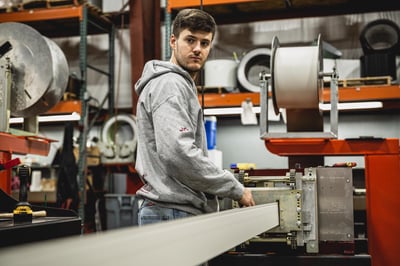
Contractors run coils through a machine like the KWM Ironman or Panther, which shapes the coil into continuous lengths right on-site. You control the run, adjust the footage, and cut it exactly where needed.
Some crews prefer a mobile setup for on-site runs, while others operate from the shop for volume production. Either way, a seamless system only performs as well as its maintenance and operator training.
Installation Workflow & Jobsite Efficiency
The workflow changes completely once you go seamless.
- Seamless gutters: Measure once, feed the coil, and form one continuous run. No hauling 10-foot sections or sealing dozens of joints. Fewer parts mean faster installs and fewer errors.
- Sectional systems: Each piece needs alignment, overlap, sealant, and fasteners. Fine for short runs or small repairs, but time-consuming on large jobs.
- Hybrid approach: Tight corners, tricky rooflines, or small retrofits may still need sectional pieces. Most contractors mix the two, seamless for main spans, sectional where access is tight.
Water Flow, Leaks & Structural Performance
- Leak prevention - Fewer joints mean fewer failure points. Each seam avoided is one less freeze-thaw crack to fix later.
- Smooth flow - Continuous runs move water efficiently, reducing turbulence and clog buildup.
- Protection - Consistent flow prevents fascia damage and foundation washout during heavy rain.
- Structural integrity - With no weak seams, the gutter holds shape longer and resists sagging under load.
Cost Modeling: Material, Labor, Waste & ROI
The upfront numbers often make contractors hesitate. Machines cost money. Training takes time. But the payback curve tells a different story.
- Coil stock is typically cheaper per foot than pre-cut sections, and waste is lower.
- Seamless installations demand fewer hours once your crew's trained.
- Seamless gutters lower the risk of leaks and failed seals.
- A machine may pay for itself in a season, depending on job volume. Contractors who run consistent residential or commercial installs may break even sooner.
Service, Maintenance Liability & Customer Value
Are seamless gutters better? In most cases, yes, especially for the contractor who owns the service calls.
With sectional systems, you can expect joint separation and sealant failure over time. Every callback means labor, travel, and customer frustration. Seamless systems drastically reduce those service tickets.
Repairs are different, too. With sectionals, you can swap a single length. With seamless, you may cut and splice, but you're usually fixing one long piece, not patching joints. The trade-off is still in your favor, less leak risk, less maintenance, happier customers.
Gutter guards and screens also fit more consistently on seamless runs, improving longterm appearance and water performance.
Retrofit, Mixed Systems & Transition Strategies
Not every structure can accommodate a full seamless run. Some older homes with irregular fascia, limited machine access, or short spans under 10 or 15 feet might call for a hybrid approach.
Transition sections bridge old to new, where seamless ends and sectional begins. Matching profiles avoids a visual mismatch, and color-matched coil helps blend the look.
If the project is upgrading from sectional to seamless, measure existing pitch, note obstructions, and plan coil runs in advance. For mixed systems, seamless where possible, sectional only where necessary, that's the smart way to balance cost and efficiency.
FAQs
In which climates is seamless most beneficial?
Anywhere with temperature swings or heavy precipitation. Fewer seams mean fewer weak spots for freeze-thaw cycles or corrosion to attack. Seamless gutters also shed debris more efficiently in regions with frequent rain or snow melt, which helps prevent ice dams and water damage.
Can one machine handle both seamless and sectional workflows?
A roll-forming machine produces continuous seamless runs. Sectional gutters are bought in pre-cut lengths rather than formed on site, so the two are not the same workflow. Most contractors run seamless from the machine for main spans and keep sectional stock on hand for tight corners and small retrofits.
Are there minimum run lengths where seamless becomes inefficient?
Short spans, roughly under 10 to 15 feet, are often quicker to handle with sectional pieces, particularly on older homes with irregular fascia or limited machine access. Above that, seamless is usually the faster and cleaner option.
How do you repair a seamless gutter if it is damaged mid-run?
With a sectional system you swap out a single length. With seamless you cut out the damaged portion and splice, so you are working on one long piece rather than patching a joint. It is a different repair, but it comes with far fewer leak points to begin with.
What kinds of seamless gutter machines does KWM Gutterman offer?
KWM Gutterman builds seamless gutter machines for K-Style, fascia, half-round and specialty gutter profiles, in 4.5", 5", 6", 7" and 8" sizes, plus combo machines that run two sizes on one frame. The IronMan line, which now forms the Max Profile as standard, covers most residential and light commercial work, with specialty profiles available for box and straight-face jobs. Every machine is manufactured and assembled in Rockdale, Illinois, and can be ordered online or through a local distributor if you want localized support and adjustment services.
Choose KWM Gutterman for Your Gutter Installation Needs
The decision between seamless and regular gutters comes down to control. Seamless systems give contractors the ability to own every inch of the process, from fabrication to finish.
When your equipment, tooling, and support come from KWM Gutterman, you won't be guessing. You're working with machines designed, built, and serviced by people who've spent decades in the trade. If you're ready to expand your capabilities or fine-tune your workflow, contact us today.